International consultation highlights need for coordinated, child-centred action against child trafficking
Chiang Mai, Thailand: Child trafficking across Asia is taking increasingly complex forms, from online sexual exploitation and forced labour to the growing risks associated with scam compounds and unsafe migration. Addressing these challenges requires more than improved detection and protection systems.
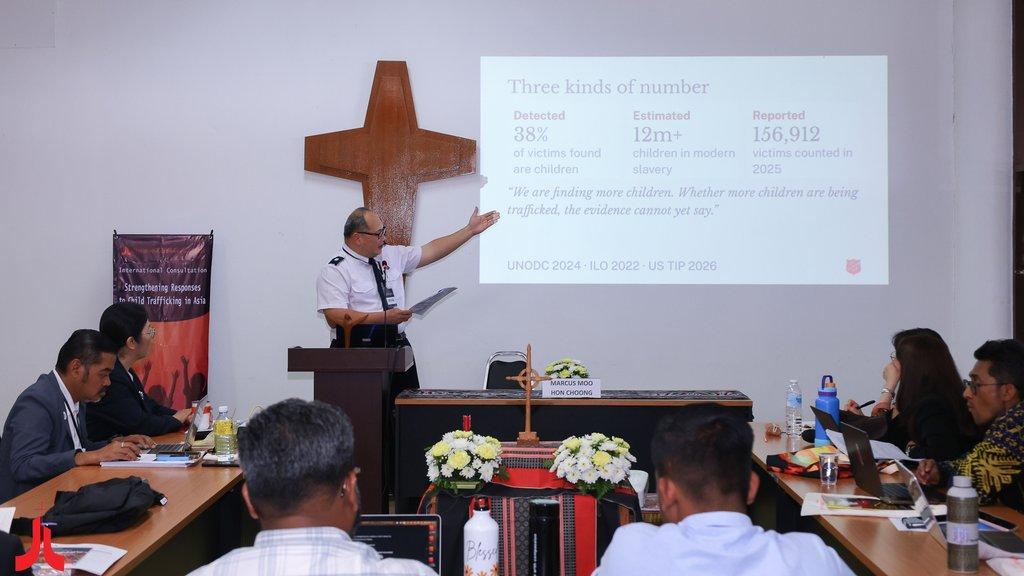
Mr Marcus Moo presenting on Child Trafficking in Asia: Trends, Drivers and Emerging Challenges
Chiang Mai, Thailand: Child trafficking across Asia is taking increasingly complex forms, from online sexual exploitation and forced labour to the growing risks associated with scam compounds and unsafe migration. Addressing these challenges requires more than improved detection and protection systems. It calls for a response that recognises the dignity of every child and places their needs at the centre, said Mr Marcus Moo Hon Choong, Territorial Director of Social & Community Services and Social Justice for The Salvation Army.
Speaking on the first day of the CCA’s International Consultation on Strengthening Responses to Child Trafficking in Asia, held from 20 to 23 October 2026, Mr Marcus Moo highlighted the drivers, emerging trends and challenges of child trafficking across the region.
He noted that trafficking can begin through seemingly ordinary circumstances, with children drawn into exploitation through job offers, family connections, online interactions or promises of a better future. Poverty and limited opportunities can increase children’s vulnerability to deceptive recruitment, while the financial gains generated by exploitation continue to fuel trafficking.
Mr Moo, who serves as Co-Chair of The Salvation Army’s SPEA Zonal Modern Slavery and Human Trafficking Response (MSHTR) Council, highlighted three pressing challenges that demand greater attention: the growing threat of scam compounds, the risks of exploitation within residential care, and cuts to international aid that threaten child-protection efforts.
Scam compounds present a complex and evolving threat, with children vulnerable to recruitment through deceptive job advertisements, sexual exploitation in and around the compounds, and online sexual extortion. Mr Moo also warned that those rescued may be treated as criminals rather than recognised as potential victims of trafficking and forced labour, underscoring the need for accurate victim identification and appropriate protection.
He further raised concerns about institutions that recruit or place children for exploitation and profit, while warning that declining international aid is putting additional pressure on child-protection services. Sustaining essential support and strengthening prevention systems are increasingly urgent, he stated.
Emphasising the human realities behind the statistics, Mr Moo said: “We are not dealing with cases. Or caseloads. Or beneficiaries. Or targets. We are dealing with souls. Each child is a soul. And each soul is priceless.”
He also reflected on the role of faith communities in protecting children and drew on the biblical account of Jesus placing a child among His disciples, urging participants to keep children at the centre of conversations about justice and protection.
Ms Pimpika Soulsby, Head of Intelligence and Identification at LIFT International in Thailand, led the session on Digital Technology, Online Exploitation and Child Protection. She explained how technology has transformed child trafficking, enabling remote and cross-border exploitation, digital surveillance, blackmail and forced criminality beyond traditional patterns of physical movement and confinement.
She highlighted how trafficking can begin with seemingly ordinary interactions before progressing through grooming, manipulation and control. Generative artificial intelligence (AI) has added further complexity, enabling the manipulation of images, voices, messages and identities. Agentic AI can also automate tasks such as identifying targets, creating false profiles and communicating with potential victims, increasing the scale and speed of exploitation while making perpetrators harder to identify.
Ms Soulsby reminded participants that control does not always involve physical confinement, but can also take the form of psychological manipulation, emotional dependency, surveillance and blackmail. She emphasised the importance of preserving digital evidence from the earliest contact and strengthening information-sharing among child-protection services, law enforcement and community partners.
She urged communities to respond to disclosures by listening calmly, reassuring children without blame, prioritising their safety and referring cases to appropriate safeguarding personnel and authorities.
H.E. Anita Ashvini Wahid, the Representative of Indonesia to the ASEAN Intergovernmental Commission on Human Rights (AICHR), highlighted how migration and displacement can increase children’s vulnerability to trafficking before, during and after their journeys.
While children move for many reasons, including education, family reunification and safety, risks arise when they lose access to trusted adults, essential services or control over their movement and documents. Displacement within a country can also leave children without safe accommodation, education, healthcare or family support.
She noted that ASEAN’s regional frameworks on trafficking and children’s rights in the context of migration provide a foundation for cooperation, but effective protection depends on how these commitments are implemented. Gaps in identification, referral and follow-up can leave children without support, particularly when they move between services or across borders. Clear responsibilities, safe information-sharing and continuity of care are essential, she said.
Ms Wahid stressed that responses must prioritise each child’s safety, best interests and right to be heard, regardless of their migration status or documentation. Decisions about family tracing, reunification or return must be based on individual assessments of the child’s circumstances and safety.
She also highlighted the role of churches as trusted first points of contact for children and families. By listening without judgement, protecting children’s privacy and connecting them with appropriate safeguarding and child-protection services, church leaders and volunteers can help children access support. Clear safeguarding procedures, designated contacts and referral pathways are essential to ensuring children receive appropriate professional care and follow-up, she noted.
The three sessions on the first day of the international consultation deepened participants’ understanding of child trafficking and reinforced the need for coordinated, child-centred responses that address the drivers of trafficking, adapt to emerging forms of exploitation and ensure children can access protection and support wherever they are.
Photo Gallery: International Consultation on Strengthening Responses to Child Trafficking in Asia