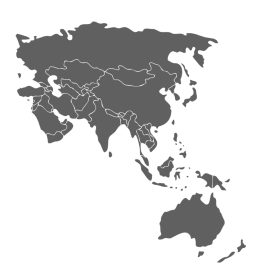
Late 19th Century
The purpose of ecumenism in Asia was different from that in the West. The Asian context warranted ecumenism beyond ecclesial unity. For the Christian missionaries, ecclesial unity was mainly in the context of coordination of mission activities in their new mission fields. Missionary-era Christianity in Asia often viewed the region's religious and cultural traditions negatively, leading to the isolation of local religions. Post-colonial indigenous churches worked to regain credibility and integrate into nation-building, resulting in a distinct Asian approach to ecumenism compared to the traditional concept of ecumenism, which was limited to only ecclesial unity.
Early 20th Century
Asian Christians protested against Western denominational divisions and fragmentation, and rejected the paternalistic approach of Western missionaries prevalent in Asia. They strongly opposed duplicating the mission strategies of colonial churches. The desire to overcome denominational divisions drove cooperation among Asian churches. The Asian ecumenical movement emerged in the early 20th century as a platform for Asian Christian identity and emancipation from external influences.
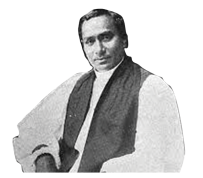
Bishop Vedanayagam Samuel Azariah,
the First Indian Bishop of the Anglican Communion
1910 World Missionary Conference in Edinburgh
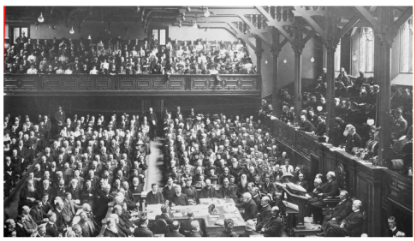
1910
Among 1,200 delegates at the 1910 World Missionary Conference in Edinburgh, 17 Asian delegates represented the non-Western world. Two notable Asian figures, VS. Azarian from India (who later became the first Indian bishop of the Anglican communion) and C.Y. Cheng from China (who was elected Chairman of the National Christian Conference) urged Westerm churches to acknowledge three crucial aspirations for Asian churches.
“collaboration in on”
“self-governance”
“unity in communal existence”
Through all the ages to come, the Indian church will rise up in gratitude to attest the heroism and self-denying labours of the missionary body. You have given your goods to feed the poor. You have given your bodies to be borned. We also ask for your love. Give us FRIENDS – V.S. Azariah
1938
The 1938 International Missionary Conference (IMC) held in Tambaram, India, marked the inception of an organisational framework for the ecumenical life of Asian churches. The Conference was instrumental in making Asian leaders see the utmost need for an Asion ecumenical body. At Tamboram, the delegates from Asian churches urged for more than mere missionary cooperation in the mission fields, they recognised their interconnectedness of the Asian churches, and the necessity of establishing procedures to embark on a shared ecumenical journey within Asis. There was also a call for the indiganisation of the Gospel and adoption of a positive approach and attitude towards other religious faiths.
1949
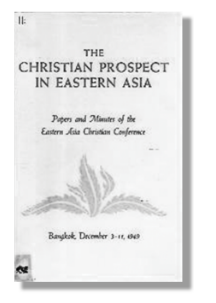
An Eastern Asia Christian Conference, on the theme "The Christian Prospect in Eastern Asia held in Bangkok in 1949, was the first occasion whera national Christian councils in Asia met after the Pacific War to consider their Christian task on a continental scale. The 1949 Bangkok Conference served as a catalyst for Asien churches to reflect on their uniqua role and vocation amidst the colonial missionary cecumstances. The World Council of Churches (WCC), founded in 1948, and the International Missionary Council (IMC), were instrumental in initiating this early gathering. However, they harboured concerns about regionalism or national priorities overshadowing a broeder ecumenical movement coordinated by WCC. The gathering of Asian representatives was not driven by an intention to seclude or limill themselves solely to the Asie region. Instead, their sim was to unity endeavours and obligations within the "whole task of the whole church for the whole world",
U Kyaw Than (Myanmar), Alan Brash (New Zealand), MM Thomas (India), and D.T. Niles (Ceylon) arriving at the Medan Airport prior to the First Assembly of the East Asia Christian Conference from 17-26 March 1957
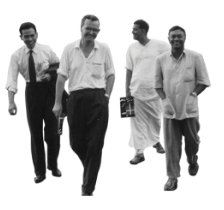
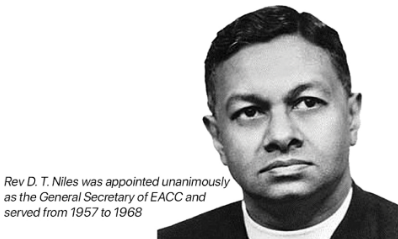
U Kyaw Than, Alan Brash, M.M Thomas and T.T. Niles, 1957
1957
The CCA, which was first known as the East Asia Christian Conference (EACC), was constituted by the decision of 107 participants representing Christian churches and national Christian councils who met at Prapat, Indonesia, in March 1957, under the theme, "The Common Evangelistic Task of the Churches in East Asia". The theme served as a starting point for Asian churches, highlighting their inherent unity due to their shared membership in the body of Christ. Exploring their common evangelistic mission prompted these churches to assess both their own circumstances and the broader Asian context in which they were called to bear Christian witness.
1959
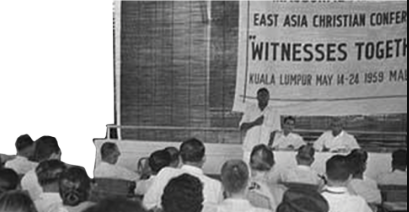
The Second Assembly was held in May 1959 in Kuala Lumpur, Malaysia, when 176 participants met under the theme “Witnessing Together”.
Believing that the purpose of God for the Church in Asia is life together in a common obedience of witness to the mission of God in the world, the Christian Conference of Asia exists as an organ and a forum of continuing cooperation among the churches and national Christian bodies in Asia within the framework of the wider ecumenical movement.
2nd Assembly
Place: Kuala Lumpur, Malaysia
Dates: 14–24 May 1959
Theme: Witnessing Together
Participants: 176 participants
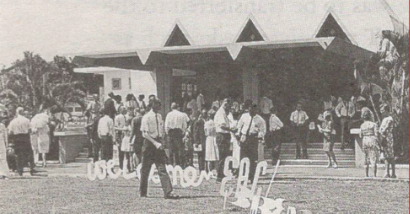
3rd Assembly
Place: Bangkok, Thailand
Dates: 25 February–5 March 1964
Theme: The Christian Community within the Human Community
Participants: 164 participants
1964
The focus of the Third Assembly held in 1964 in Bangkok, Thailand, was "The Christian Community within the Human Community". The theme reflected a greater awareness of the church within the larger society. The human community was its context and its frame of reference. The church as the Christian community existed for the sake of the human community. 164 participants deliberated on two major concerns, 'the problems-arising from the dialogue of the Church with the world' and the 'issues which the Churches must face in their call to renewal'.
1968
4th Assembly
Place: Bangkok, Thailand
Dates: 30 January–8 February 1968
Theme: In Christ, All Things Hold Together
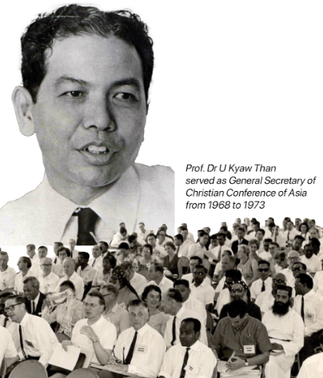
The Fourth Assembly met again in Bangkok, Thailand, in 1968, under the theme “In Christ, All Things Hold Together”. The Assembly addressed a divided Church in a broken world and discussed topics such as making the Christian presence effective and ecumenical cooperation.
1973
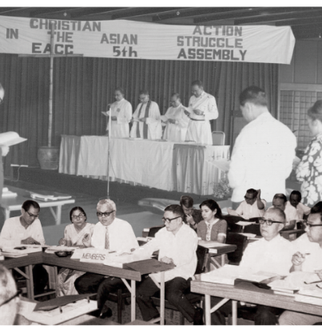
5th Assembly
Place: Singapore
Dates: 6–12 June 1973
Theme: Christian Action in the Asian Struggle
Participants: 289 participants
"Christian Action in the Asian Struggle" was the theme of the Fifth Assembly in Singapore, 1973, which brought together 289 participants. The emphasis was on action, and the framework for action was the struggles of the Asian people-such as poverty and powerlessness. Prophetic witness and Christian action were determined as being integral to the response of churches.
It was decided to formally change the name of the East Asia Christian Conference (EACC) to the Christian Conference of Asia (CCA), reflecting a common understanding in the Asia region. It was also here that the participants insisted on a balanced representation of church executives, laity, women, and youth.
1975
1975 marked the beginning of the CCA's annual observance of "Asia Sunday". Asia Sunday is usually observed each year on the Sunday before Pentecost, and it coincides with the anniversary of the CCA's founding in 1957.
1975 was also when the Asian Ecumenical Centre, was initiated. This later became the Asian Ecumenical Course and is now known as the Asian Ecumenical Institute. The AEC was a month-long ecumenical formation course for leadership development which was held annually, and became a training ground for church and ecumenical leaders in Asia.